

How Much Storage Space Do You Really Need in a Motorhome?
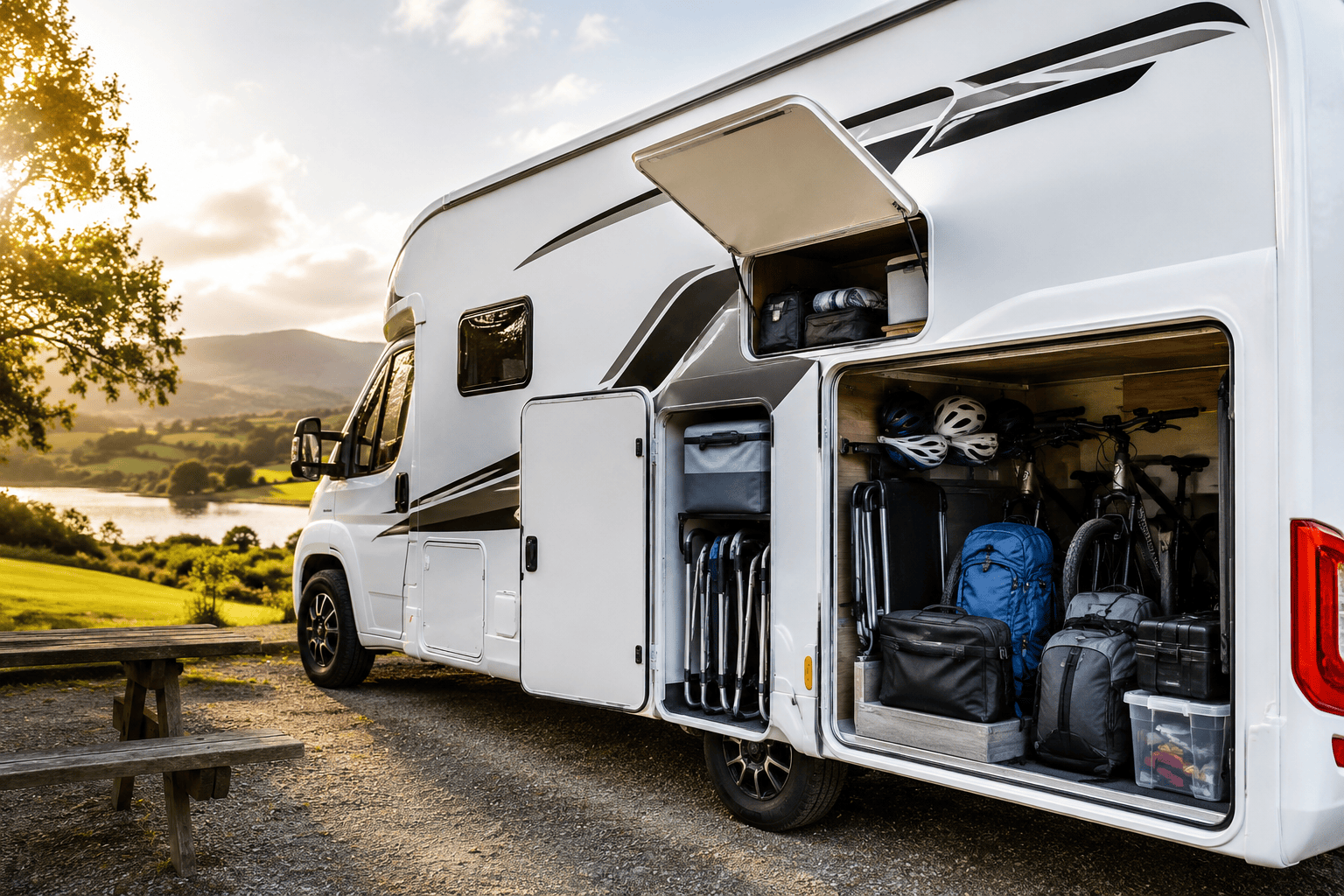
Imagine: You’ve just picked up one of the latest motorhomes for hire, the key is in the ignition, and the open roads of the NC500 or the rolling hills of the Cotswolds are calling your name. You look in the rearview mirror, and the living space looks pristine and ready for adventure.
Then comes the reality check: loading day. Suddenly, you’re staring at a small mountain of walking boots, crumpets, rain jackets, portable BBQs, and your kids’ favourite board games. You start shoving things into the overhead lockers, under the seats, and into the rear garage.
It raises a question every road tripper faces: How much storage space do you actually need? Getting your motorhome storage layout right isn’t just about avoiding a messy living space.
In the UK, it’s a strict legal requirement, a safety necessity, and the secret to a stress-free holiday. Let’s break down how to balance your packing list without turning your dream trip into an overloaded nightmare.
The Legal Truth: Payload vs. Spatial Storage
When planning your packing for motorhome travel, it’s easy to focus on physical space. If it fits in the cupboards, it’s fine, right? Not quite. Every vehicle on UK roads has a legal weight limit known as the Maximum Technically Permissible Laden Mass (MTPLM).
The difference between the empty weight of the vehicle (Mass in Running Order) and this maximum limit is your payload. If you passed your driving test in the UK after 1st January 1997, you are likely restricted to driving vehicles up to 3,500kg on a standard Category B licence.
To stay under this threshold, many manufacturers build large 4-to-6-berth motorhomes right up to the limit, leaving you with a surprisingly small payload margin, sometimes as little as 300kg to 400kg for all your gear, water, and passengers.
If you opt for a premium experience and look up the most luxurious motorhome models on the market, they often feature massive rear “garages” capable of holding scooters and bikes.
However, because these vehicles are packed with high-end appliances, heavy leather interiors, and solid cabinetry, their actual weight capacity can disappear instantly.
Storage Needs by Trip Style: Couples vs. Family Holidays
The amount of motorhome storage space and payload capacity you need scales dramatically depending on who is joining the ride.
The Couples’ Getaway
If there are just two of you booking a motorhomes hire, a compact campervan or a low-profile two-berth coachbuilt is usually plenty.
You will generally need around 150kg to 200kg of payload for your personal belongings. Most standard layouts offer more than enough overhead lockers and under-bed storage for two people travelling light.
The Family Holiday
Taking a family of four or five on a staycation changes the equation entirely. An average family requires at least 500kg to 600kg+ of usable payload.
- The Passenger Weight: Remember, every passenger adds weight that chips away at your legal allowance.
- For families, a motorhome with a dedicated rear garage or an over-cab bed layout is vital to keep the living space clear and functional.
- The Bulk Factor: Kids mean extra outdoor toys, massive piles of clothes for unpredictable British weather, and triple the food supplies.
How to Maximise Your Motorhome Storage Space
If you are heading out on a multi-week expedition, space becomes premium real estate. Here is how seasoned UK travellers keep things organised:
- The Weight Distribution Rule: Always store your heaviest items (like tools and awning gear) low down and close to the axle lines. Packing heavy items in top lockers ruins the vehicle’s centre of gravity, leading to terrifying body roll on standard UK roundabouts.
- The Soft-Sided Luggage Rule: Never bring hard, plastic suitcases into a motorhome. They are impossible to store once empty. Use collapsible duffle bags that can be folded down flat and slid under a mattress.
- Utilise Vertical Space: Install nesting storage boxes inside the deep rear garages. Use command hooks on the inside of wardrobe doors for jackets and keys.
Packing Smart: What to Bring Without Overloading
The golden rule of motorhome storage is simple: If you don’t need it, leave it behind. Here is a quick framework to audit your gear before setting off:
- Ditch the Water Weight: Water weighs 1kg per litre. Driving with a full 100-litre fresh water tank means you are wasting 100kg of precious payload on the motorway. Instead, travel with just 20 litres and fill up your main tank when you arrive at your campsite.
- The Food Audit: Don’t stock up on weeks of heavy tinned goods from your local supermarket before you leave. Buy fresh, local produce as you travel. It supports rural UK economies and saves your vehicle’s suspension.
- Swap for Lightweight Materials: Trade your heavy household stoneware mugs and plates for lightweight melamine or bamboo sets. Swap bulky iron skillets for nesting, aluminum camping cookware.
Conclusion
Ultimately, mastering motorhome storage comes down to balancing spatial awareness with legal weight limits.
By adopting a minimalist approach to packing for motorhome travel, you can protect your payload and keep your living space uncluttered. Pack smart, travel light, and enjoy the freedom of the open road without the extra baggage.
FAQs
How much storage space do you really need in a motorhome for a family holiday?
For a family of four, look for a motorhome that offers a dedicated rear garage or large under-seat cavities, alongside a minimum of 500kg to 600kg of payload capacity. It ensures you have physical room for bulky outdoor gear and the legal weight allowance to carry it safely.
What should you pack for motorhome travel without overloading your vehicle?
Focus on multi-purpose, lightweight essentials: aluminium cookware, microfiber towels, and collapsible storage bins. Pack clothing for about a week and plan to use the campsite laundry facilities. Crucially, leave the freshwater tank mostly empty until you reach your destination.
How do you maximise motorhome storage space on long trips?
Use vacuum-seal storage bags for off-season clothes and extra bedding to cut down on bulk. Invest in stackable, clear plastic storage boxes for the rear garage so you can find items quickly without unpacking the entire vehicle at every stop.
What are the best motorhome storage ideas for UK travellers?
Utilise non-slip matting inside cupboards to stop crockery rattling on bumpy country lanes. Use over-door pocket organisers in the bathroom, and secure hanging tension rods in deep lockers to create instant, temporary shelving units.
How much luggage can you safely carry in a motorhome in the UK?
The safe amount depends on your specific vehicle’s payload rating. On a standard UK Category B licence, your total allowance for all luggage, extras like bike racks, and all passengers typically ranges between 300kg and 600kg. Always check your vehicle’s weight plate!